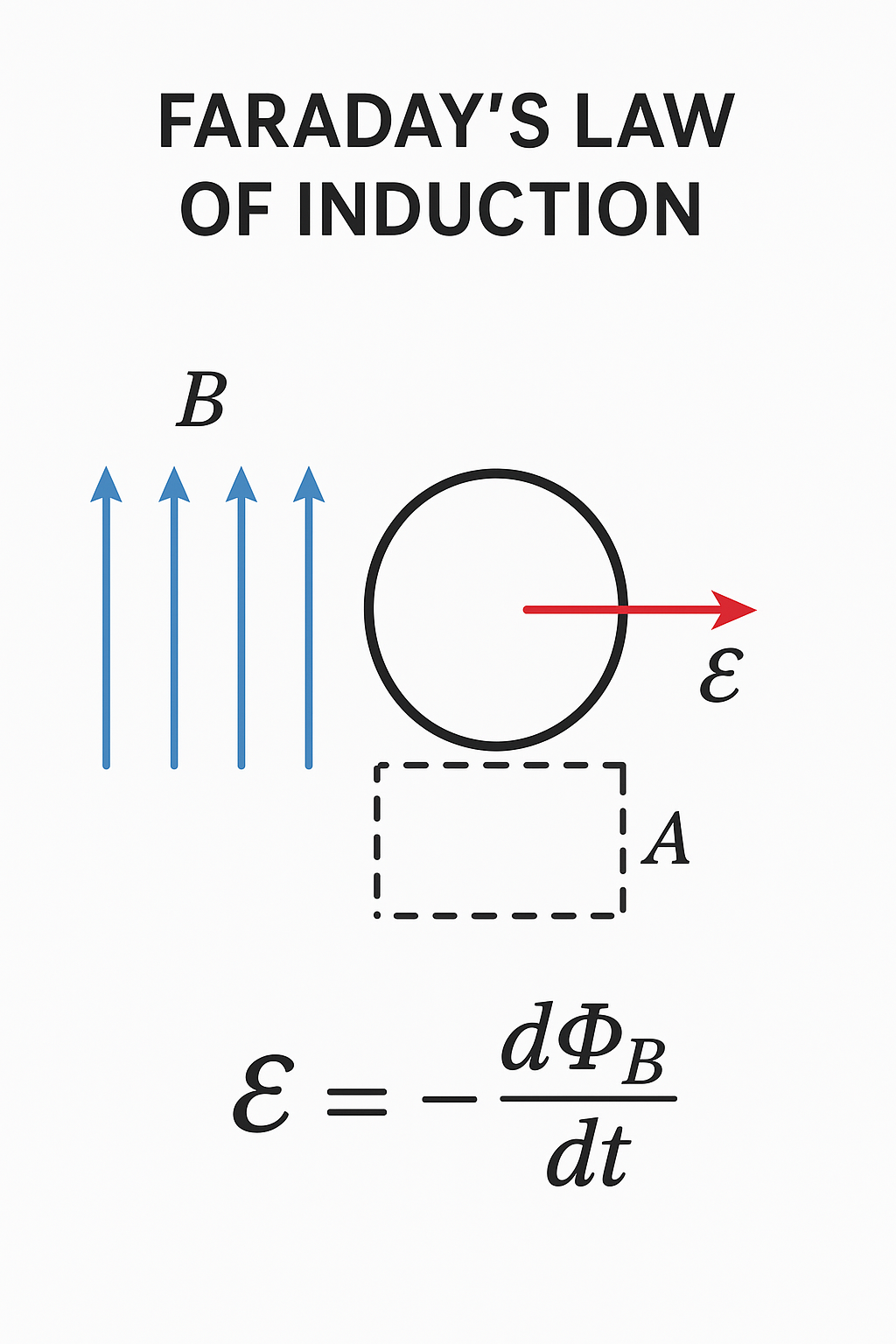
Faraday’s Law of Induction is a fundamental principle in electromagnetism that describes how a changing magnetic field can produce an electric field, and consequently an electric current, in a conductor. In simple terms:
Statement:
The induced electromotive force (EMF) in a closed loop is equal to the negative rate of change of magnetic flux through the loop.
Mathematically, it is expressed as:
E=−dΦBdt\mathcal{E} = -\frac{d\Phi_B}{dt}
Where:
-
E\mathcal{E} = induced EMF (voltage)
-
ΦB\Phi_B = magnetic flux through the loop
-
dΦB/dtd\Phi_B/dt = rate of change of magnetic flux
-
The negative sign comes from Lenz’s Law, which states that the induced current will oppose the change in magnetic flux that produced it.
Magnetic Flux (ΦB\Phi_B) is defined as:
ΦB=B⋅A⋅cosθ\Phi_B = B \cdot A \cdot \cos\theta
Where:
-
BB = magnetic field strength
-
AA = area of the loop
-
θ\theta = angle between the magnetic field and the normal to the loop
Key Idea:
If the magnetic field through a loop changes—either in strength, area, or orientation—an electric current is induced in the loop.
Practical Examples:
-
Electric generators (mechanical energy → electrical energy)
-
Transformers
-
Induction cooktops